

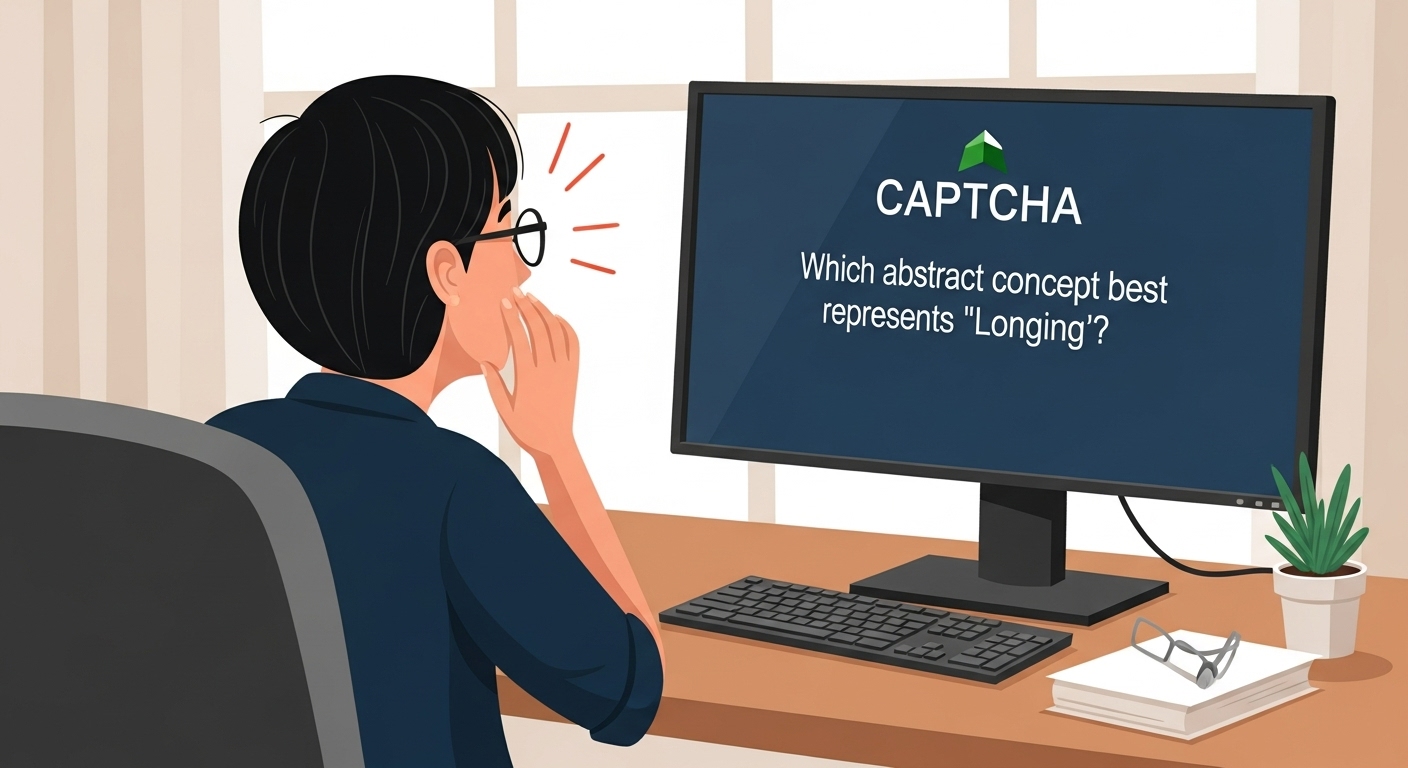
I failed my humanity test. Wept, I did, a single tear tracing a path through the grime of a week spent wrestling with “Which abstract concept best represents ‘Longing’?” The answer, apparently, was not “a half-eaten bag of chips,” as I had confidently clicked. My bank account remained stubbornly locked, a digital vault guarded by an increasingly philosophical turn in online security.
According to Dr. Aris Thorne, head of the newly formed Global Directorate of Digital Sentience Validation (GDDVV), the era of “Click all squares containing a fire hydrant” is as dead as dial-up. “With AI so adept at discerning fire hydrants, frankly, it was insulting to both human and machine intelligence,” Dr. Thorne explained during a recent holocast. “Our new protocols demand a deeper dive into the nuances of human experience. We’re looking for… soul, frankly.”
The GDDVV’s latest quarterly report, “The Turing Test’s Existential Crisis,” paints a grim picture for those of us clinging to our meat-suit identities. It predicts that by 2030, 87% of all online interactions will require users to either compose a haiku reflecting on the transient nature of existence, or correctly identify which of five blurry images depicts “mild disappointment.” A recent survey, conducted by a bot that then failed its own CAPTCHA, revealed that 63% of internet users now experience “pre-verification anxiety” before attempting to log into their email. This figure jumps to 92% for those attempting to access government services.
My own struggles are far from unique. Just last week, my neighbor, Brenda, a woman who once navigated a particularly complex IKEA assembly without breaking a sweat, was locked out of her online grocery account. Her offense? Mistaking “the quiet desperation of a Monday morning commute” for “a slightly undercooked casserole.” Brenda, now a fervent believer in the “offline is the new online” movement, has resorted to bartering garden tomatoes for essential pantry items.
The future of human verification tests isn’t just about security; it’s a profound exploration into what it truly means to be human in a world increasingly populated by digital doppelgangers. Perhaps, as some theorists suggest, these tests are less about keeping bots out and more about reminding us, the increasingly fragmented and screen-addicted masses, that we still possess the unique, messy, and often illogical qualities that define our species. Now, if you’ll excuse me, I have to go try to log into my social media, and I hear today’s challenge involves correctly identifying the precise shade of beige that best embodies “existential dread.” Wish me luck.