

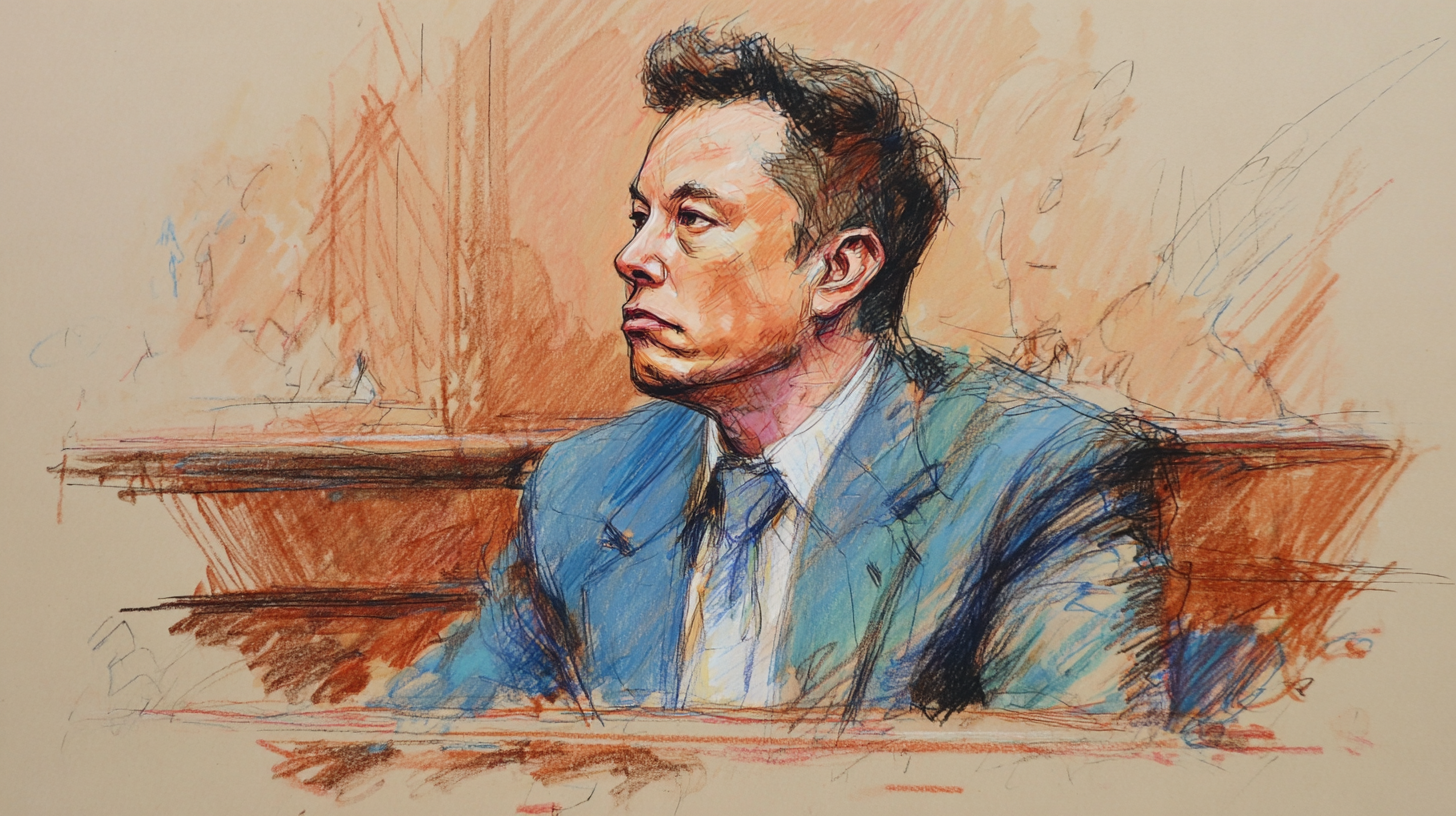
Elon Musk has once again stepped into the courtroom of public opinion, this time with actual court papers. According to filings that may or may not have been printed on SpaceX rocket schematics, Musk sues Apple and OpenAI for what he describes as “a conspiracy to make AI too useful, too polite, and too interested in reading bedtime stories.” The lawsuit, filed in the “District Court of Cosmic Justice” (a jurisdiction he apparently just founded on Mars), claims Apple and OpenAI colluded to create a monopoly on telling people what they already know in a slightly more reassuring voice.
Musk’s legal team, which includes three Tesla robots and one intern who forgot how to open Excel, argues that Siri whispering bedtime affirmations and ChatGPT writing wedding vows have caused “irreparable harm” to his own AI project, xAI. One exhibit submitted to the court shows a pie chart where 95% of the pie is labeled “Musk’s Hurt Feelings” and the remaining 5% is “actual legal merit.” Experts say it’s the most honest legal chart ever produced.
Industry insiders are baffled. “This case will either redefine antitrust law or be remembered as the lawsuit where a billionaire demanded exclusive rights to sarcasm,” said Dr. Penelope Cray, senior analyst at the National Bureau of Unnecessary Litigation. A leaked memo from Apple responded tersely with, “Who?” while OpenAI’s statement consisted entirely of shrugging emojis printed on legal stationary.
Projections show that if Musk wins, every iPhone will be legally required to open with a three-minute video of him explaining free speech. If he loses, Musk has promised to counter-sue gravity itself for colluding with physics. Rumors also swirl that he may challenge Microsoft for “staring at him funny” and Netflix for “stealing the concept of time-wasting.”
Meanwhile, shareholders are reportedly thrilled, as the news pushed Tesla stock up by 0.003% on the hope that Musk would get distracted enough to stop tweeting. A fake but oddly believable poll by the Department of Public Distractions shows that 62% of Americans believe the case is “entirely made up,” 23% think it’s “performance art,” and the remaining 15% simply answered “Dogecoin.”
Whether or not Musk’s lawsuit succeeds, one truth remains: nothing brings America together like watching billionaires sue each other over who gets to control a virtual assistant that refuses to understand your Wi-Fi password.